

ADاشتہار / AdvertisementGoogle Ad
D-8 Chief Calls for Stronger Halal Economy CooperationPakistan
D-8 Secretary-General Sohail Mahmood urges stronger cooperation, investment and trade partnerships to build a sustainable and inclusive global halal economy.
Share:
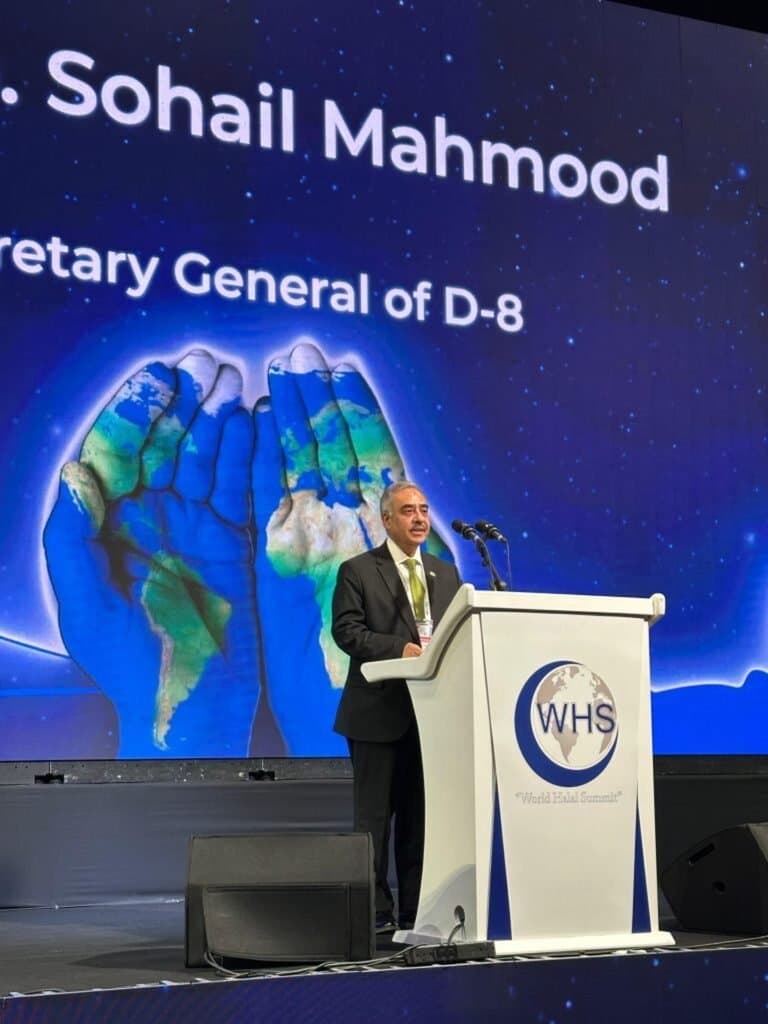
ISTANBUL — Secretary-General of the Developing-8 Organization for Economic Cooperation (D-8), Ambassador Sohail Mahmood, has called for stronger international cooperation, investment and trade partnerships to harness the potential of the global halal economy as a driver of sustainable economic growth.
He was addressing the opening ceremony of the 12th World Halal Summit and Halal Expo 2026 at the Istanbul Expo Center, where he highlighted the need to strengthen halal standards, develop sustainable value chains and mobilise investment for a more inclusive and competitive global halal economy.
ADاشتہار / AdvertisementGoogle Ad
The four-day event, being held from November 25 to 28 under the auspices of Turkish President Recep Tayyip Erdogan, is themed “Sustainable Halal Economy: Eliminating Waste, Empowering Growth”. It has brought together government officials, international organisations, halal certification authorities, business leaders, academics and industry experts.
The opening ceremony featured addresses by high-level dignitaries, including Turkish Minister of Trade Prof Dr Ömer Bolat, as well as senior representatives of participating countries and international and regional organisations.
In his remarks, Ambassador Mahmood commended the Government of Türkiye and the organisers for convening the summit on a timely and forward-looking theme. He highlighted the significance of the Islamic principles of Halal and Tayyib, together with the Islamic injunction against wastefulness, in fostering an economic model that reconciles commercial prosperity with environmental stewardship and social responsibility.
The Secretary-General underlined the immense potential of the global halal economy as a driver of economic growth, innovation, investment and employment generation. Referring to the scale of global food waste, he stressed that eliminating waste was not merely an environmental responsibility but also an economic necessity.
In this context, he recalled the special message of the First Lady of Türkiye, Emine Erdogan, to the D-8 High-Level Ministerial Session on Climate Action held during COP31 in Antalya, in which she stressed food waste prevention, improved resource efficiency, education and greater public awareness. She also encouraged the development of a D-8 Zero Waste Roadmap in line with the priorities of member states.
Ambassador Mahmood also highlighted the recently adopted Antalya Ministerial Action Framework on D-8 Climate and Environmental Cooperation and reaffirmed the organisation’s commitment to contributing to the global Zero Waste Movement.
He underlined the progressive integration of the halal economy within the D-8’s strategic priorities, as illustrated by the convening of the inaugural D-8 Halal Expo in Indonesia in July 2026. He noted Indonesia’s intention, as the incoming D-8 Chair, to accord priority to the halal economy during its chairmanship, as well as its proposal to host a D-8 Halal Economy Cooperation Secretariat.
In furtherance of the D-8’s target of achieving US$500 billion in intra-D-8 trade by 2030, the Secretary-General reiterated his proposals for an Integrated D-8 Halal Trade Corridor and a Digital Halal Marketplace and Investment Platform. Such initiatives, supported by the effective use of the D-8 Preferential Trade Agreement and closer cooperation with SMIIC, could facilitate market access, strengthen investment flows, enhance supply-chain efficiency and promote industrial innovation across member states, he said.
He set out three strategic priorities for advancing cooperation in the halal economy: strengthening halal standards, certification and mutual recognition arrangements; developing sustainable halal value chains through digital transformation, the responsible use of artificial intelligence, resource-efficient production and circular economy solutions; and mobilising investment and financing.
Related Coverage