ADاشتہار / AdvertisementGoogle Ad
Pakistan Climbs 17 Places in UN E-Government IndexPakistan
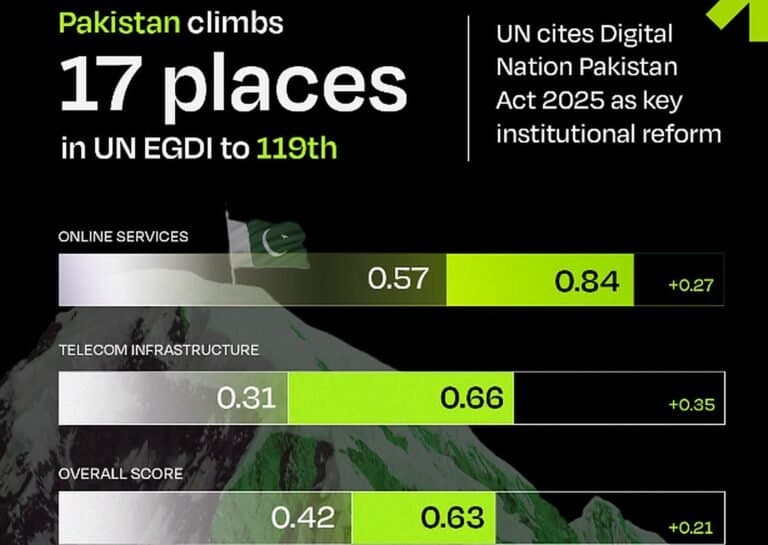
The jump to 119th place, from 136th in 2024, is Pakistan’s best-ever showing in the UN survey, driven by strong gains in online services and telecom infrastructure.
Share:
ISLAMABAD: Pakistan has climbed 17 places to rank 119th among 194 countries in the United Nations E-Government Development Index (EGDI) 2026, its highest position on record, according to the results published in the UN E-Government Survey 2026.
The country’s overall EGDI score rose from 0.5096 in 2024 to 0.6264 in 2026, an improvement of about 23 per cent. It is Pakistan’s second consecutive improvement in the ranking: the country stood 150th in 2022 and 136th in 2024, meaning it has gained 31 places in four years. Pakistan has also moved up from the Middle EGDI category to the High EGDI category.
ADاشتہار / AdvertisementGoogle Ad
Broad-based gains in services and connectivity
The progress has been broad-based. Pakistan’s score for online services increased by 20 per cent to 0.8422, the second-highest in Southern Asia, reflecting the growing availability of government services through digital channels. Its score for telecommunication infrastructure rose by 39 per cent to 0.6590, building on a 52 per cent increase in the previous edition, as connectivity continues to expand across the country.
Pakistan also recorded the highest score in Southern Asia for online participation and engagement, at 0.9655. The indicator measures the extent to which citizens can take part in government processes through online consultations, feedback mechanisms and access to public information.
The UN Survey links Pakistan’s progress to the Digital Nation Pakistan Act, 2025, noting that the improvement coincides with the enactment of the legislation, which set up a more formal institutional framework for national digital transformation. The Act also established the Pakistan Digital Authority (PDA) to coordinate digital transformation across federal and provincial governments. The United Nations has recognised Pakistan among the largest gainers in Southern Asia.
Federal Minister for Information Technology and Telecommunication Shaza Fatima Khawaja said the rise of 31 places across two editions of the UN benchmark was the result of sustained work across federal and provincial institutions to put public services online and bring connectivity to more people. She said it showed that Prime Minister Muhammad Shehbaz Sharif’s Digital Nation vision was being delivered and that the world was taking note.
Chairperson of the Pakistan Digital Authority Dr Sohail Munir said the UN had recognised the Digital Nation Pakistan Act as the institutional foundation for coordinated digital transformation, and that the task now was to build on it through shared digital public infrastructure and interoperable systems that work the same way for a citizen in any province.
The survey also points to a weak spot. The human capital index, which measures literacy and schooling, rose by only 8 per cent to 0.3778, making it the weakest of the country’s pillars even though it carries a third of the overall index. The IT ministry says closing that gap is the next frontier, with a focus on digital skills through programmes such as DigiSkills, ICT for Girls, semiconductor design and artificial intelligence training. The government says it will carry the progress into the next phase of the Digital Nation agenda, extending digital services, connectivity and digital skills to every part of the country.
Tags:Digital PakistanE-Government Development IndexPakistan Digital AuthorityShaza Fatima KhawajaUN EGDI
Related Coverage