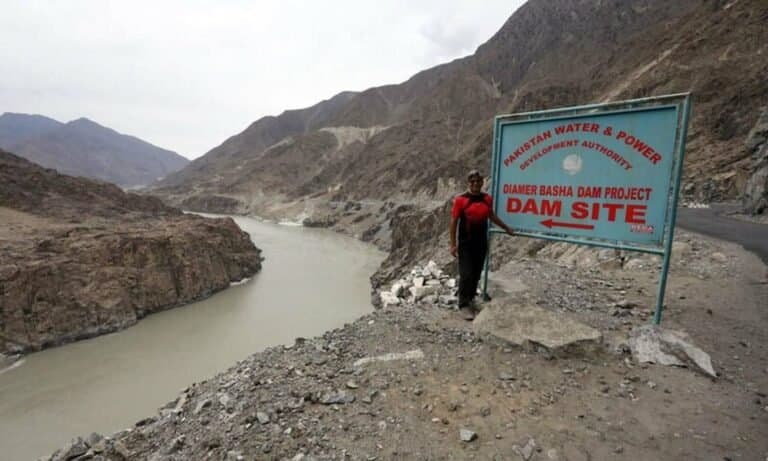
Wapda has signed a Rs133.18 billion hydro-mechanical contract with the Power China-IKAN Joint Venture, taking the Diamer-Bhasha Dam into its specialised equipment phase.
LAHORE: The Pakistan Water and Power Development Authority (Wapda) has signed a Rs133.18 billion agreement with the Power China-IKAN Joint Venture for the hydro-mechanical (HM-1) contract of the Diamer-Bhasha Dam project, marking a major step forward for one of the country’s largest water and energy schemes.
According to a Wapda spokesperson, the agreement was signed on Saturday at Wapda House by Diamer-Bhasha Dam Project Chief Engineer and Project Director Arif Ali on behalf of the authority, and Ling Jianke, the authorised representative of the joint venture.
ADاشتہار / AdvertisementGoogle Ad
Wapda Chairman retired Lt Gen Muhammad Saeed attended the signing ceremony, along with the authority’s members for finance, water and power, the chief executive officer of the Diamer-Bhasha Development Company, a delegation from the joint venture led by the Power China International Group Limited chairman, and representatives of the consultants.
<h2>What the contract covers</h2>
The HM-1 contract covers the project’s hydro-mechanical equipment and hydraulic steel structures. The work includes the manufacture, supply and installation of gates and steel structures used to control water flows at the dam.
According to Wapda, the equipment will be installed at the flushing tunnels on both banks of the river, at the power intakes and at the dam outlets. The contract also covers steel lining, hoisting and pumping systems, and related electrical works.
Officials say these components are essential to the safe and efficient operation of the dam, as they regulate how water moves through the structure, feed the power generation units and allow sediment to be flushed from the reservoir.
<h2>A priority project for water, food and energy security</h2>
The spokesperson said the Diamer-Bhasha Dam is a priority project of the federal government for ensuring the country’s water, food and energy security. The dam is being built across the Indus River, about 40 kilometres downstream of Chilas.
Upon completion, it will have a gross water storage capacity of 8.1 million acre-feet and an installed power generation capacity of 4,500 megawatts, figures that underline its scale compared with most existing reservoirs in the country.
The project has long been presented by successive governments as central to managing Pakistan’s water shortages, expanding affordable hydropower and providing storage to smooth out seasonal variations in river flows. Saturday’s agreement moves the project from civil construction into the specialised equipment phase, with gates and steel structures among the most technically demanding parts of the build.
With the HM-1 contract now signed, attention will turn to the manufacturing and delivery schedule for the equipment and its installation at the dam site. Wapda has not announced a revised completion date in connection with this contract, and the authority says work will proceed in line with the project’s overall construction programme.