

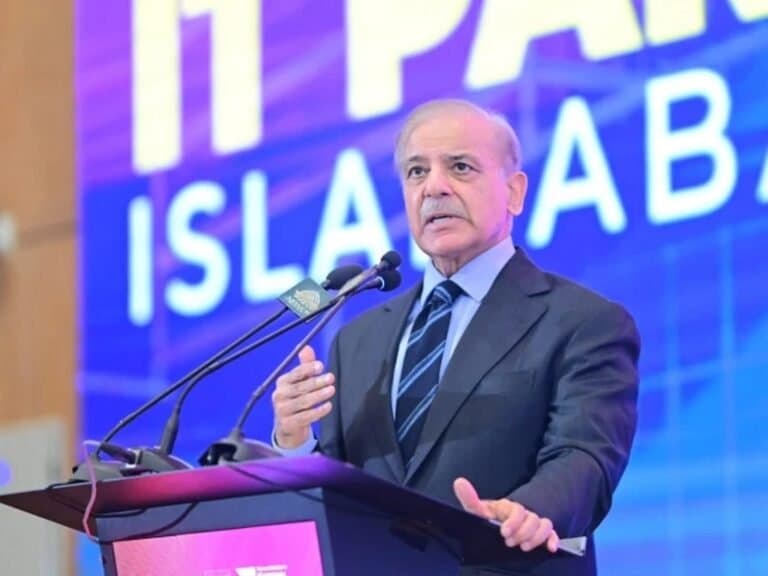
PM Shehbaz Inaugurates Daanish IT Park in Islamabad
Prime Minister Shehbaz Sharif inaugurated Islamabad's National Technology Park as the Daanish IT Park, calling it a milestone for Pakistan's digital future.
By: hammadkhaksar
Google's new Astra chips, built with Synaptics, promise 40% lower power consumption — a move that could finally make always-on AI practical on smart glasses and smartwatches.

Google Research has previewed a new line of low-power artificial intelligence chips designed to bring smarter AI directly onto wearable devices, promising to cut energy consumption by 40 per cent compared with existing products. The Astra chip line, developed jointly with American chipmaker Synaptics, was unveiled on Wednesday at Google’s annual Research@ showcase at the company’s headquarters in Mountain View, California.
Unlike conventional AI chips that send data to distant cloud servers for processing, the Astra chips are built for edge AI — running artificial intelligence tasks directly on small devices such as smart glasses and smartwatches. Because the processing happens on the device itself, responses are faster and the risk of sensitive data leaking during transmission is reduced. The trade-off has always been that such chips must be extremely power-efficient and produce little heat, a barrier Google says its new hardware now overcomes.
<h2>Always-on AI ambition</h2> Avinatan Hassidim, vice president of Google Research, said conventional edge chips were slow and used too much energy, making an always-on ambient AI experience impossible. The new chip uses the M2, a successor to the Coral Neural Processing Unit, an AI compute engine Google introduced last year. The chip is expected to handle voice, video, motion and context detection in real time on wearable devices, allowing phones and glasses to understand their surroundings continuously without constantly waking power-hungry main processors.
Rahul Patel, the chief executive of Synaptics, said the chip would not stay in the laboratory and would be built into Google devices, although he did not specify which products or when they would be released. Synaptics plans to reveal detailed specifications and demonstrate the chip at its own event on October 20. The partnership extends the two companies’ earlier collaboration: Synaptics unveiled the first Astra chip series last October, the first to commercialise Google’s Coral neural processing platform, and earlier this year built the Coral Board development platform around it.
At the same event, Google Research also shared other projects, including Google Earth AI for predicting environmental and public health conditions, Deep Review for checking the logic and factual accuracy of technical documents, and TimesFM, a forecasting model for time-series data. The Astra announcement reflects a broader industry shift toward on-device intelligence, as companies race to put AI assistants into wearables that users can wear all day without draining the battery.
Prime Minister Shehbaz Sharif inaugurated Islamabad's National Technology Park as the Daanish IT Park, calling it a milestone for Pakistan's digital future.
By: hammadkhaksar
OpenAI has started rolling out GPT-6 to ChatGPT users worldwide, led by a new 'Intelligent UI' that presents answers as interactive charts, buttons, forms and small tools, with paid tiers first from October 7 and free users from October 8.
By: hammadkhaksar
Pakistani organisations have secured recognition in 11 categories at the ASOCIO Digital and AI Awards 2026, signalling growing regional confidence in the country's digital and artificial intelligence capabilities.
By: hammadkhaksarStay updated with the latest news, breaking developments, and insightful coverage from Azad Kashmir and Pakistan.
Follow on Facebook