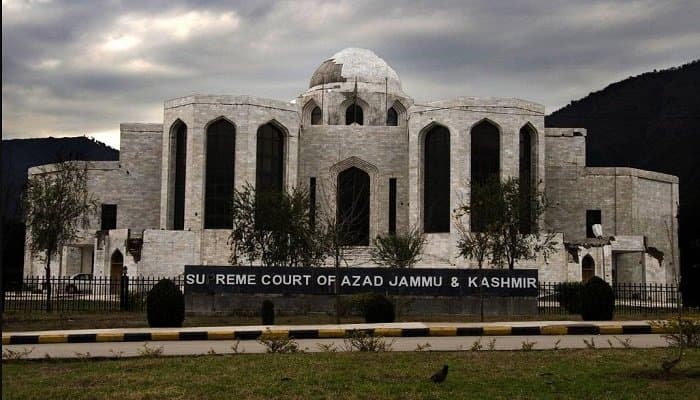
Muzaffarabad’s top court has drawn a line under one of Azad Kashmir’s most contested questions, ruling that regional and refugee quotas in government jobs cannot simply be wiped away — but cannot continue forever without justification either.
The Supreme Court of Azad Jammu and Kashmir (AJK) on Wednesday set aside the blanket abolition of regional and refugee quotas in public employment, ruling that geographical preferences are not inherently unconstitutional but must be supported by law and evidence of under-representation.
A division bench comprising Chief Justice Raja Saeed Akram and Justice Khalid Yousaf Chaudhary announced the judgment in Muzaffarabad. The court also directed the Public Service Commission (PSC) to resume and complete all pending recruitment processes that had been suspended following the high court’s verdict of August 16, 2025.
The bench stopped short of restoring the decades-old quota percentages. Instead, it directed the government to undertake a comprehensive review of the existing regional and refugee allocations and bring them in conformity with constitutional and statutory requirements.
Interim recruitment framework
Until that review is completed, the court prescribed an interim geographical recruitment framework. Vacancies in grades 1 to 7 would ordinarily be filled through competition among candidates from the relevant constituency, while those in grades 8 to 15 would be filled at the district level.
Vacancies in grades 1 to 15 at divisional offices would be filled through competition among candidates from the division concerned, while posts in state-level institutions, irrespective of grade, and all posts in grades 16 and above would be filled on open merit among State Subjects.
The court clarified that selection within each geographical field would remain strictly subject to prescribed qualifications, suitability and merit. If no suitable candidate was available within the primary geographical area, the recruitment process would be extended to a wider field in accordance with the applicable rules.
What the court said about the law
Authored by Chief Justice Akram, the judgment held that the High Court had erred in treating every form of regional, area-based or refugee-related recruitment arrangement as inherently unconstitutional. It observed that the statutory framework under the AJK Civil Servants Act, 1976, and the Civil Servants Rules, 1977, recognised the government’s authority to provide proper representation to the component units of the AJK territory and refugees settled in Pakistan.
However, the bench held that such authority was not unlimited, and that historical quota arrangements could not be continued indefinitely without a rational and objectively ascertainable justification.
Refugee quotas not perpetual
The bench also dealt separately with the quota reserved for refugees settled in Pakistan, observing that their status as State Subjects was independent of the continuation of any particular preferential allocation.
It held that neither the 19 per cent quota for refugees who migrated in 1947 nor the 6 per cent allocation for those who migrated in 1989 could be treated as a perpetual entitlement without a continuing constitutional and statutory justification.
Admissions and past decisions
On educational admissions, the court ruled that regional preferences had to be examined independently of public-sector recruitment. The bench further set aside the high court’s directives concerning federal and provincial institutions and educational seats beyond the constitutional and administrative competence of the AJK government, observing that these were governed by their respective constitutional, statutory and inter-governmental arrangements.
The court ruled that appointments and admissions already finalised under the legal regime prevailing at the relevant time should not be disturbed solely on account of its decision.
It also held that the high court was not competent to declare the quota arrangements repugnant to the injunctions of Islam, as such jurisdiction vested in the Shariat Appellate Bench under the relevant law.