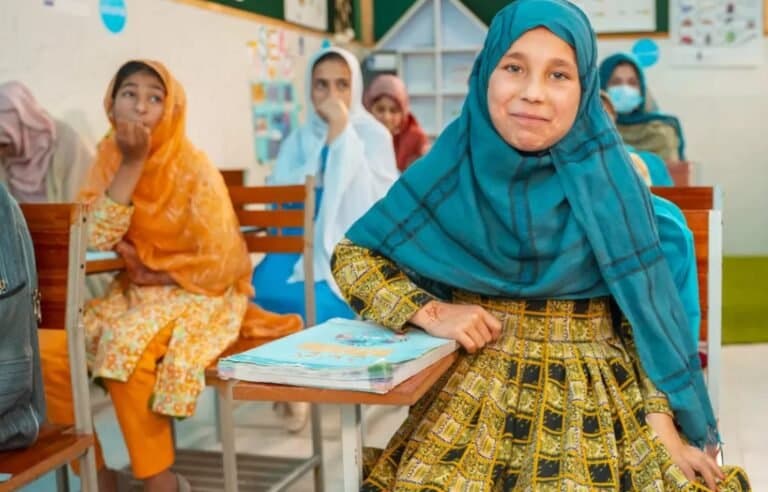
Children in Quetta marked World Children’s Day by sharing simple, hopeful dreams: to go to school, to learn, and to build a better future. The day, observed around the world on November 20, was held this year under the theme “My Day, My Rights, My Future”, and in Balochistan it became a moment for young voices to speak about what education means to them.
Saima Qasim, a fourth-grade student at Model Public High School in Quetta, summed up the wish shared by many of her classmates. “I wish that everyone goes to school, makes new friends, receives quality education, and returns home happily,” she said.
Musawir Ali, a student of class VIII, said every child should enjoy fundamental rights, especially equal opportunities for quality education. He urged parents to send their children to school, so that no child is left behind.
To mark the day, UNICEF illuminated government buildings in Quetta with blue lights, including the Balochistan Assembly, the Balochistan High Court, the Deputy Commissioner’s Office and the UNICEF provincial office. Fitsum Assefa, UNICEF’s Chief Field Officer in Balochistan, said UNICEF is committed to the welfare, education and protection of children, and that the organisation has been working for children’s well-being for 80 years.
Provincial Education Minister Raheela Hameed Khan Durrani said the government has made steady progress in bringing children back to school. In about two and a half years, she said, around 750,000 children have been brought back into education, more than 3,500 previously closed schools have been made functional, and 14,000 teachers have been appointed. She said Rs24 billion has been allocated for education, 186 buses have been proposed for students, and transport and solar systems are being provided in educational institutions, along with one-time meals, financial assistance and scholarships.
She added that 400 girls from Balochistan who are pursuing higher education at leading universities have been awarded fully funded scholarships.
The scale of the challenge is set out in the Balochistan Education Statistics Report 2023-24, published by the School Education Department. It records 15,270 schools in the province and 1,079,962 students enrolled in government institutions, of whom 55.5 percent are boys and 44.5 percent are girls, a girls-to-boys enrolment ratio of 0.80. According to the Pakistan Bureau of Statistics Labour Force Survey 2020-21, the literacy rate for people aged 10 and above in Balochistan is 54.5 percent, with men at 69.4 percent and women at 36.8 percent, while literacy among rural women is 31.1 percent.
The report also points to the challenges that remain, including non-functional schools, limited facilities in remote areas and disparities in girls’ enrolment. For the children who spoke on the day, though, the message was clear: with schools open, teachers in place and families behind them, they believe a brighter future is within reach.