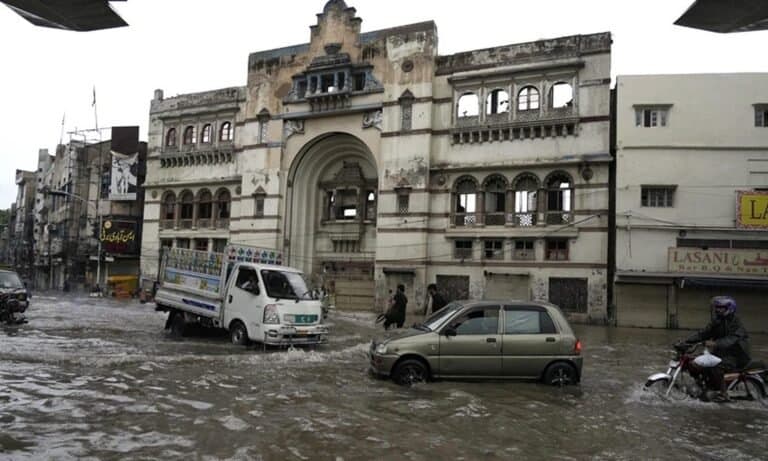
Lahore received light rain on Friday, bringing the city its first real relief from a week of choking smog, as overnight showers washed dust and pollutants from the air and pushed the city’s air quality index down from hazardous levels.
The Pakistan Meteorological Department recorded 3.8 millimetres of rain in Lahore city and 1.4 millimetres at the airport over the past 24 hours, with rain and thunderstorms reported at isolated places across the city. The showers came as a shallow westerly wave that entered the country on Tuesday strengthened over the upper parts of Pakistan, bringing the rain the Met Office had forecast for Lahore on November 12 and 13.
Air quality improves, but remains unhealthy
The change was visible in the air quality readings. Lahore’s air quality index stood at 394 on Thursday, a hazardous reading that once again placed the city among the world’s most polluted, according to data reported by Dawn. By Friday morning, the index had fallen to 159, still in the unhealthy range but far below the peaks of the past week. The provincial environment department had forecast the index would fall to 218 on Friday, and the improvement was enough for Delhi to move ahead of Lahore on the global ranking of the most polluted major cities.
The relief, however, is only partial. An index of 159 still means the air is not satisfactory, with fine PM2.5 particles the main pollutant, and health experts advise residents to limit prolonged outdoor activity, wear masks and keep children indoors when pollution is high.
A week of hazardous air
The rain arrived after days in which Lahore repeatedly topped the world’s most polluted cities list. The city recorded no rain at all between November 1 and 10, while still air allowed pollution to build. A Pakistan Air Quality Initiative report found Lahore’s average PM2.5 concentration was 126 micrograms per cubic metre between October 1 and November 9, eight times the World Health Organisation’s guideline, and the city breached the national 24-hour air quality standard on all 40 days measured.
Officials have blamed a mix of local emissions, including transport, crop-residue burning and waste burning, and pollution drifting across the border from Indian Punjab after Diwali celebrations, with easterly winds carrying fine particles into the region.
Fog likely after the rain
The Met Office has warned that fog could form over the plains after the rain, cutting visibility for motorists in the mornings, and the National Disaster Management Authority has issued an alert for rain, thunderstorms and night-time fog and smog in Lahore and other Punjab cities. The westerly system is expected to persist over the upper parts of the country until the morning of Saturday, November 14, after which conditions are expected to improve. Temperatures in Lahore are forecast to stay mild, with a high of around 29 degrees Celsius and a low of 17 on Friday, and the rain is also expected to bring cooler weather in the coming days.