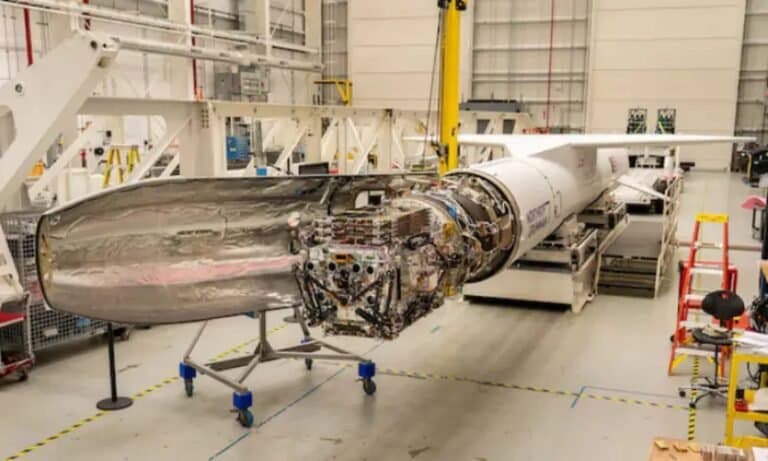
NASA’s Swift satellite telescope, which spent two decades studying the most powerful cosmic explosions, has tumbled out of orbit and burned up in Earth’s atmosphere over Indonesia.
The spacecraft fell from orbit as expected on Wednesday, 4 November, according to the reports, ending a mission that had lasted far longer than anyone had planned. Swift was launched in 2004 on what was meant to be a two-year mission, but it kept working for twenty years beyond that, outliving its planned lifespan by two decades.
Swift was 5.6 metres long and weighed 1,470 kilograms. Its job was to watch for gamma-ray bursts, the most powerful explosions in the universe, and to study them in detail. Over its long life, it detected more than 1,600 gamma-ray bursts and observed about 4,000 blazars, the bright cores of distant galaxies.
The telescope also observed about 1,200 supernovae, the violent deaths of stars, and more than 1,000 flaring stars. It discovered about 800 gamma-ray bursts with unknown origins, which NASA said could be among the highest-energy supernovae ever found.
The end of the mission had been expected for some time. NASA lost contact with Swift in December 2025, and in January 2026 the agency said it was no longer possible to control the satellite. From that point, its fall back to Earth was a matter of time, and scientists had predicted it would burn up in the atmosphere rather than reaching the ground.
That is what happened on Wednesday, when the spacecraft tumbled out of orbit and burned up over Indonesia. Satellites that re-enter the atmosphere at high speed heat up and break apart, and in Swift’s case the whole spacecraft was destroyed in the fall.
Swift’s long career made it one of the most productive space telescopes ever flown. Gamma-ray bursts last only seconds, and catching them needs a telescope that can turn quickly to look at the right part of the sky. Swift was designed to do exactly that, and it sent alerts to telescopes on the ground so they could study the afterglow of each burst.
The data it collected helped astronomers understand where gamma-ray bursts come from and how they are linked to the deaths of massive stars and the collision of dense objects in space. Its observations of supernovae and blazars added to that picture, building a record that scientists will keep studying for years.
The mission also showed how much extra value can be got from a spacecraft that keeps working beyond its planned life. Swift was built for two years and delivered twenty-two, a return that NASA has pointed to as an example of what a well-built observatory can achieve.
With the telescope now gone, its legacy lives on in the catalogue of bursts, supernovae and other objects it recorded, and in the scientists who learned their trade working with its data. The fiery end over Indonesia closes the story of a mission that was meant to be brief and turned out to be one of NASA’s longest-running successes.