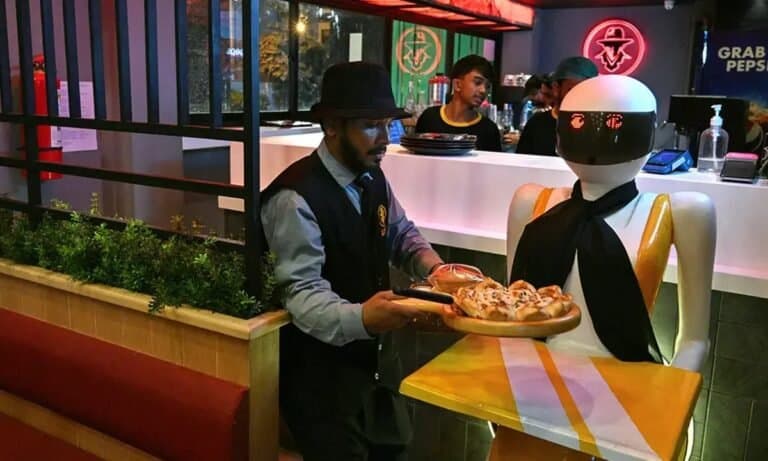
In a busy Karachi dining room, the newest member of the wait staff glides between booths on wheels, pauses at a table, and speaks. “Welcome to Sicilian. My name is Robia,” she says in an electronic voice, her red LED eyes blinking as diners look up from their menus. Beside her works Jojo, the second of two humanoid robot waitresses now serving guests at The Sicilian restaurant.
The pair have quickly become the restaurant’s star attraction. Shaped with spherical white heads and dark visors that resemble a motorcycle helmet, the robots wear black shawls around their necks in the style of a dupatta. They move from table to table carrying plates — pizza among the dishes — and when they arrive, customers lift the food off their serving trays themselves or wait for a human member of staff to step in.
Behind the spectacle is a homegrown story. The robots were built by Pakistani engineer Syed Osama Aziz, who also founded the restaurant, through his robotics company Cobot. Most of the parts were manufactured locally, with the circuit boards designed and programmed in his own laboratory, although some electronic components were imported from abroad. His workshop is based in Multan, in the province of Punjab.
A restaurant that doubles as a showcase
For Aziz, the restaurant is as much a demonstration of what Pakistani engineering can do as it is a place to eat. The machines are built around locally made components, a point of pride for a project that shows off domestic manufacturing rather than relying on imported finished robots. Guests who come for the food often end up filming the servers instead, and the robots have turned an ordinary dinner into something people talk about long after they leave.
Yet the robots are far from finished. Aziz plans to add camera-based processing and image-processing features so that a robot can recognise a customer and remember what they ordered last time. The idea is simple: a returning guest would be greeted not only by name, but with suggestions shaped by their previous visit.
That ambition points to a wider trend. Around the world, restaurants have experimented with machines to carry food, take orders and cut waiting times, but most of those systems arrive ready-made from large overseas manufacturers. Here, the machines were designed and assembled close to home, by the same person who opened the restaurant they work in.
For now, Robia and Jojo keep to their rounds: wheeling through the dining room, stopping at each booth, and letting diners help themselves from the tray. The human staff remain close by, stepping in whenever a guest needs a hand. The robots may not yet remember your last order — but if their creator’s plans work out, they soon will.