
ADاشتہار / AdvertisementGoogle Ad
Chinese Motorcycles Now Take a Third of Europe’s Big BikesBusiness
Chinese brands now supply nearly a third of Europe’s big-bike imports, up from 7% in 2019, as CFMoto and rivals win buyers at Milan’s EICMA show.
Share:
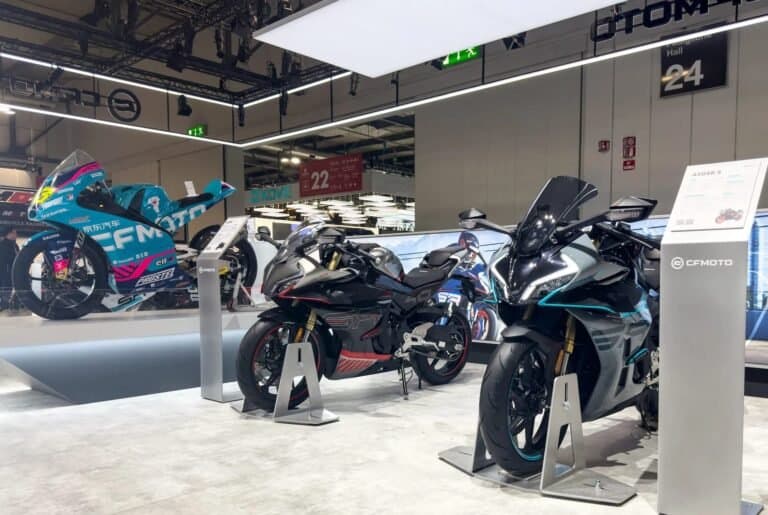
Chinese motorcycle makers are no longer a curiosity on the edge of the European market. At the EICMA show in Milan, Europe’s biggest motorcycle exhibition, visitors crowded around the stand of CFMoto on Friday, examining powerful machines that now compete directly with long-established Japanese and European brands.
The shift is backed by hard numbers. According to a report published on Thursday by the European Association of Motorcycle Manufacturers, known as ACEM, China became the European Union’s second-largest supplier of motorcycles in 2025, behind only Japan, accounting for 27.1 percent of imports worth one billion euros.
ADاشتہار / AdvertisementGoogle Ad
The growth has been fastest in the most powerful models, a segment long dominated by European and Japanese manufacturers. In six years, China has gone from a marginal supplier to a key player: it now accounts for nearly one-third of imports of motorcycles over 250cc, compared with just seven percent in 2019.
CFMoto, based in the Chinese city of Hangzhou, has led the advance. The company first gained attention by producing engines and assembling models for Austria’s KTM, and then by winning two Moto3 world championships, in 2024 and 2026. In France, CFMoto established itself in October as the fifth brand on the market, overtaking long-standing names such as Triumph, Suzuki, KTM and Yamaha, according to the French automotive association Mobilians.
Other Chinese brands are following the same path. Zontes has doubled its sales in a year, while QJMotor and Voge are also growing fast in France, Mobilians said. QJMotor, part of the Qianjiang group, bought the Italian brand Benelli back in 2005, while newer names such as ZXMoto, founded by former mechanic and rider Zhang Xue, have used events like the Dakar Rally to build an international profile.
Price and quality win over sceptics
Visitors at the Milan show said the appeal was simple: strong design and equipment at a price that undercuts the established brands. Renato Polistene, a 64-year-old Italian craftsman looking at the CFMoto stand, said the bikes were beautiful and that, even if the materials were not exactly the same as those used by Japanese manufacturers, at this price it works. He currently rides a KTM but said he could consider a Chinese bike next time, especially as prices elsewhere have risen sharply.
Bertrand Mace, president of the two-wheel division at Mobilians, described the trend in France as a true revolution coming from the East. Aggressive pricing, combined with an undeniable move upmarket, is hitting the mark with customers whose purchasing power is under pressure, he said.
The European press, which first looked at the Chinese bikes with scepticism, now tests them like any others in comparison reviews. For the British magazine Motorcycle News, 2026 is the year where we see a switch. With sales still climbing and the Milan show drawing crowds to the Chinese stands, the established brands face a challenge that is no longer about the future, but about the present.
Related Coverage