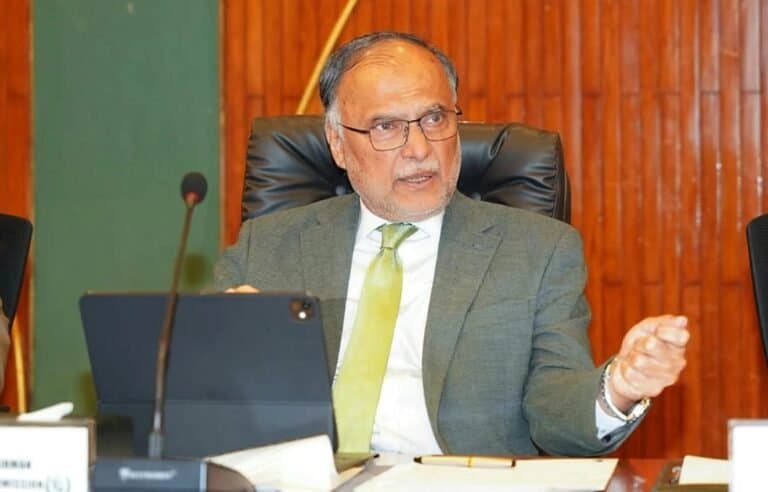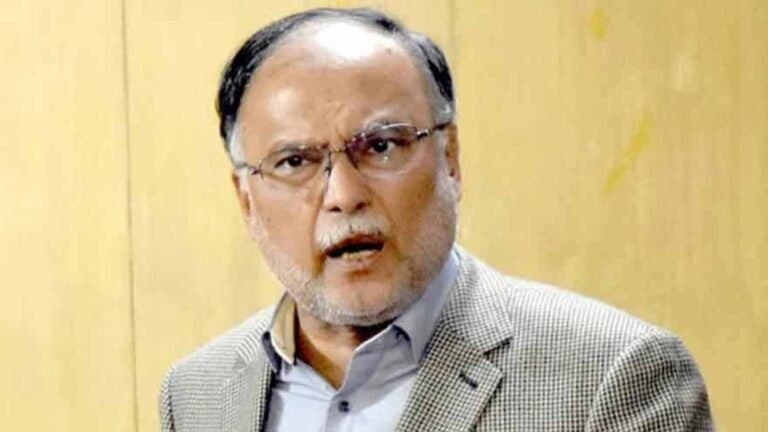


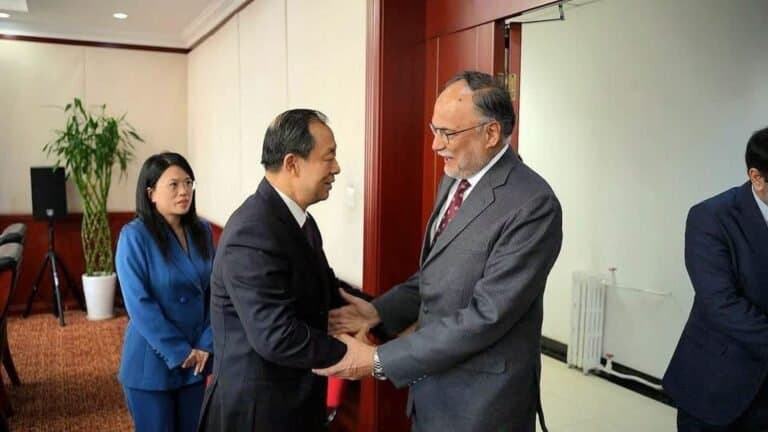
Federal Minister for Planning, Development and Special Initiatives Professor Ahsan Iqbal on Saturday discussed research cooperation with China to develop a practical road-map for increasing Pakistan’s annual exports to over $100 billion by 2035.
During a meeting in Beijing with Lu Hao, President of the Development Research Center (DRC) of China’s State Council, the minister discussed a proposed joint research project between the DRC and the Pakistan Institute of Development Economics (PIDE) to draw lessons from China’s economic experience and identify ways to enhance Pakistan’s export potential.
Ahsan Iqbal said Pakistan’s path to economic sovereignty lay through exports, stressing that the country’s development journey could be disrupted whenever import expenditure grew faster than foreign exchange earnings, resulting in pressure on foreign exchange reserves.
He said exports constituted the first of the five pillars of URAAN Pakistan, adding that his discussions with the Chinese leadership had focused on exploring ways to help Pakistani manufacturers and farmers increase their products’ sales in international markets with China’s cooperation.
The proposed joint research initiative aims to provide practical guidance to Pakistani exporters on identifying markets where the country’s products could increase their market share and the measures required to achieve that objective.
The minister emphasised that securing the confidence of overseas buyers and establishing long-term business relationships through repeat orders would help create employment opportunities in Pakistan and generate foreign exchange.
He said stronger export earnings would enable the country to pursue its development priorities with greater reliance on its own resources.
The $100 billion export target is a central part of the government’s URAAN Pakistan framework, under which exports are the first of five pillars alongside energy, environment, equity and E-Pakistan, and the minister has previously said economic sovereignty depends on increasing exports beyond $100 billion by 2035.
According to earlier reporting, the framework aims to transform Pakistan into a one-trillion-dollar economy by 2035, while continuing with existing policies would take the economy to only around $600 billion by that year.
The minister has also said that boosting exports by $20 billion over the next four years is essential to reduce dependence on IMF financing, with agriculture, industry, services, information technology, mining, the blue economy, manpower and creative industries identified as the sectors capable of driving export growth.