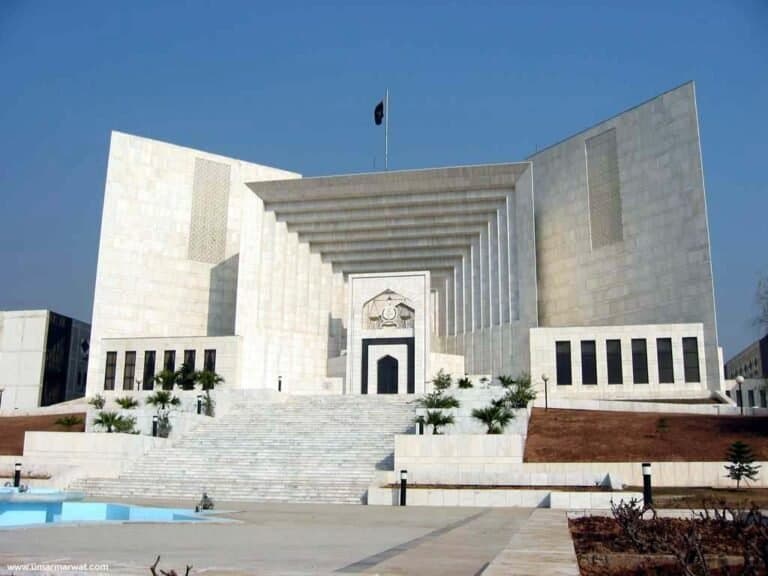
ISLAMABAD — The Supreme Court has laid down a clear rule for disputes over property: appointing a receiver is an extraordinary judicial step, and it can only happen when there is proof that the property faces an imminent risk of loss, damage or unlawful transfer.
The court made it plain that a receiver cannot be appointed merely because one side asks for it. Whoever seeks it must show strong grounds and a compelling need for the court to step in at once, otherwise the measure becomes an unjustified interference with ownership rights.
A two-member bench of Justice Muhammad Ali Mazhar and Justice Irfan Saadat Khan set out the principles in a case about the dealership and inheritance shares of Kohinoor Petrol Pump in Hyderabad. The judgment was authored by Justice Mazhar.
The court drew a line between two different remedies. A temporary injunction requires a prima facie case, balance of convenience and irreparable loss. A receiver demands more: stronger grounds and a pressing need for immediate intervention.
The case history runs like this. The petitioners had sought a declaration and a permanent injunction over the petrol pump. The trial court dismissed their temporary-injunction application on 30 May 2025. On 5 August 2025, the appellate court ordered the pump’s seal to be reopened and restrained interference in the dealership for six months or until final disposal, on condition that the alleged 29.17 per cent share of Mrs Nisa Farhan Memon was deposited with the Nazir. Then, on 20 October 2025, the Sindh High Court set aside the appellate order and appointed the trial court’s Nazir as receiver of Kohinoor Petroleum Service, Hyderabad.
The Supreme Court observed that the real question before the appellate court was only whether the trial court had rightly dismissed the injunction application. The High Court, it said, went beyond that question and appointed a receiver, even though the underlying dispute had not been properly examined and the two subordinate courts’ orders did not agree with each other.
The court also held that under Section 115 of the Code of Civil Procedure, the High Court’s revisional jurisdiction is limited to correcting errors of law or jurisdiction — not to rehearing a case or granting relief beyond what was asked for. The inheritance-shares dispute is already pending before the trial court and cannot be decided conclusively at an interim stage.
A receiver, the court emphasised, should be appointed only when it is indispensable for preserving the disputed property.